

If you’ve been thinking about becoming a truck driver but can’t picture yourself sitting in a classroom for weeks on end, you’re not alone. That’s exactly why online truck driving classes have become such a popular starting point for people who want flexible, affordable driver training without putting their current job or family responsibilities on hold. At SSW, we built our program around the idea that learning the rules of the road shouldn’t mean uprooting your life to do it.
Whether you’re switching careers, supplementing your income, or chasing the freedom of life on the highway, online truck driving classes give you a real, practical way to get there on your own schedule.
The Problem with Traditional Truck Driving Schools
Let’s be honest traditional truck driving schools ask a lot of you. Many require full-time attendance for four to six weeks, which is a tough ask if you’ve got a job, kids, or bills that don’t pause while you study. On top of that, in-person programs often come with higher tuition once you factor in commuting, missing work hours, and sometimes even relocation. For a lot of aspiring drivers, that’s simply not realistic.
This is where online truck driving classes step in to fill the gap. Instead of forcing your life to bend around a rigid class schedule, SSW’s program lets you complete the (theory) portion of your training whenever it fits early mornings, late nights, weekends, whatever works for you. You still get behind-the-wheel training with certified instructors when it’s time for the hands-on portion, but the bulk of the knowledge-based learning happens on your terms.
What You Actually Learn in Online Truck Driving Classes
A common misconception is that online truck driving classes only cover the bare minimum needed to pass a permit test. That’s not the case with a properly built program. At SSW, our curriculum walks you through everything required under the federal government’s entry-level driver training standards, including:
- Basic operation of a commercial vehicle
- Safe driving practices and rules around driving hours and rest breaks
- Vehicle inspection procedures
- Cargo handling and securement
- Non-driving safety knowledge, like hazard awareness and emergency procedures
Because the course is self-paced, you’re not rushed through material the way you might be in a compressed in-person course. If a topic like air brake systems or trip planning doesn’t click the first time, you can go back over it as many times as you need. That kind of flexibility tends to lead to better retention and better retention means you walk into your driving exam more confidently.
Who Benefits Most from Online Truck Driving Classes
Online truck driving classes aren’t for everyone, but for a lot of people, they’re a genuinely better fit than the traditional route. A few examples of who tends to thrive in this format:
Career changers who are still working their current job can’t afford to take weeks off for full-time training. Parents and caregivers who need to build learning time around school pickups, appointments, or other responsibilities. Rural residents who live far from a physical driving school would otherwise face long commutes just to sit through lectures. Military veterans transitioning to civilian work who are used to disciplined, self-directed learning and want to move at their own pace.
If any of that sounds like you, online truck driving classes might be the missing piece that finally makes a trucking career possible.
How SSW Structures Its Online Truck Driving Classes
We didn’t want to just put some PDFs online and call it a course. SSW’s online truck driving classes are built as a structured, step-by-step system that mirrors what you’d get in a physical classroom just without commuting.
Here’s roughly how it breaks down:
- Enrollment and orientation
You get access to your student portal, and a walkthrough of how the course works.
2. Self-paced classroom lessons
Video lessons, reading material, and quizzes covering everything required by federal driver-training standards.
3. Progress tracking
You and your instructor can both see exactly where you stand, so nothing falls through the cracks.
4. Scheduling behind-the-wheel training
Once you’ve completed the classroom portion, you schedule in-person driving sessions at a time that works for you.
5. Final review and testing support
Before you’re taking your driving exam, you get review sessions and practice tests to make sure you’re ready.
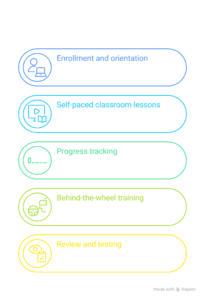
This hybrid approach online for classroom learning, in-person for the driving tends to give students the best of both worlds. You save time and money on the classroom side, but you’re still getting real, supervised experience behind the wheel before you’re ever tested.
Cost and Time Savings
One of the biggest draws of online truck driving classes is the cost. Traditional schools often charge a premium for facility use, in-classroom instructor time, and sometimes even housing if the school isn’t near you. By moving the classroom portion online, SSW can keep tuition more manageable while still delivering a full, government-compliant curriculum.
Time savings matter just as much. Instead of blocking off four to six weeks of full-time attendance, many students complete their online truck driving classes in a timeframe that fits around their existing work schedule some finishing the classroom portion in as little as two to three weeks of part-time study, though pace varies by student.
Frequently Asked Questions
Will an online program prepare me for the driving exam?
Yes if the school follows the federal entry-level driver training requirements (which SSW does), the classroom knowledge translates directly to what’s tested on your permit and licensing exams.
Do I still need in-person training?
Absolutely. No legitimate program including SSW’s claims you can earn a commercial driver’s license without behind-the-wheel instruction. Online truck driving classes cover the knowledge-based portion; driving itself still requires hands-on, supervised practice.
Is online training respected by employers?
Most trucking companies care far more about whether you hold a valid license and have completed properly compliant training than about whether your classroom hours happened online or in person.
How long does it take to finish online truck driving classes?
It depends on your pace, but many students complete the classroom portion in two to three weeks of part-time study, then move into scheduled behind-the-wheel sessions.
Can I start online truck driving classes with no prior experience?
Yes. The courses are built for beginners and walk you through everything step by step, starting with the basics of commercial vehicle operation.
Conclusion
Choosing how you train for your commercial driver’s license is a bigger decision than it might seem, it affects your budget, your timeline, and how well you retain what you learn. If a rigid classroom schedule doesn’t fit your life right now, SSW’s online truck driving classes offer a realistic alternative: the same government-compliant curriculum, the same qualified instructors for your driving hours, but built around your schedule instead of the other way around.
Trucking remains one of the few careers where you can start with zero experience and be earning solid pay within weeks. For students who need flexibility without cutting corners on quality, online truck driving classes are proving to be the smarter way to get there. If you’re ready to take the first step, SSW’s enrollment team can walk you through exactly what to expect from day one to your final exam.
- ELDT → “entry-level driver training standards”</li>
One thing worth flagging: the “Points” list at the end of your original document (about a 1.5-month course, Japan job placements, the katsudo visa, JFT requirements, etc.) describes a very different program an online course preparing students for truck-driving work in Japan than the U.S.-style commercial driver’s license content in the article above. If that Japan-focused program is what SSW offers, this article may need a deeper rewrite, not just a word swap, since the whole premise (federal U.S. licensing rules, U.S. trucking careers) wouldn’t apply. Let me know if you’d like me to rewrite it around that program instead.